Gas Laws Cheat Sheet
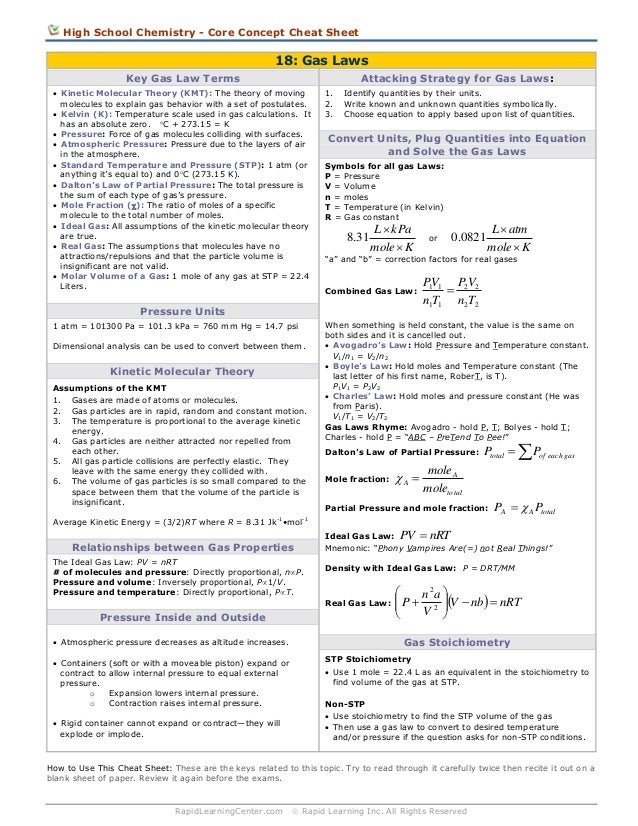
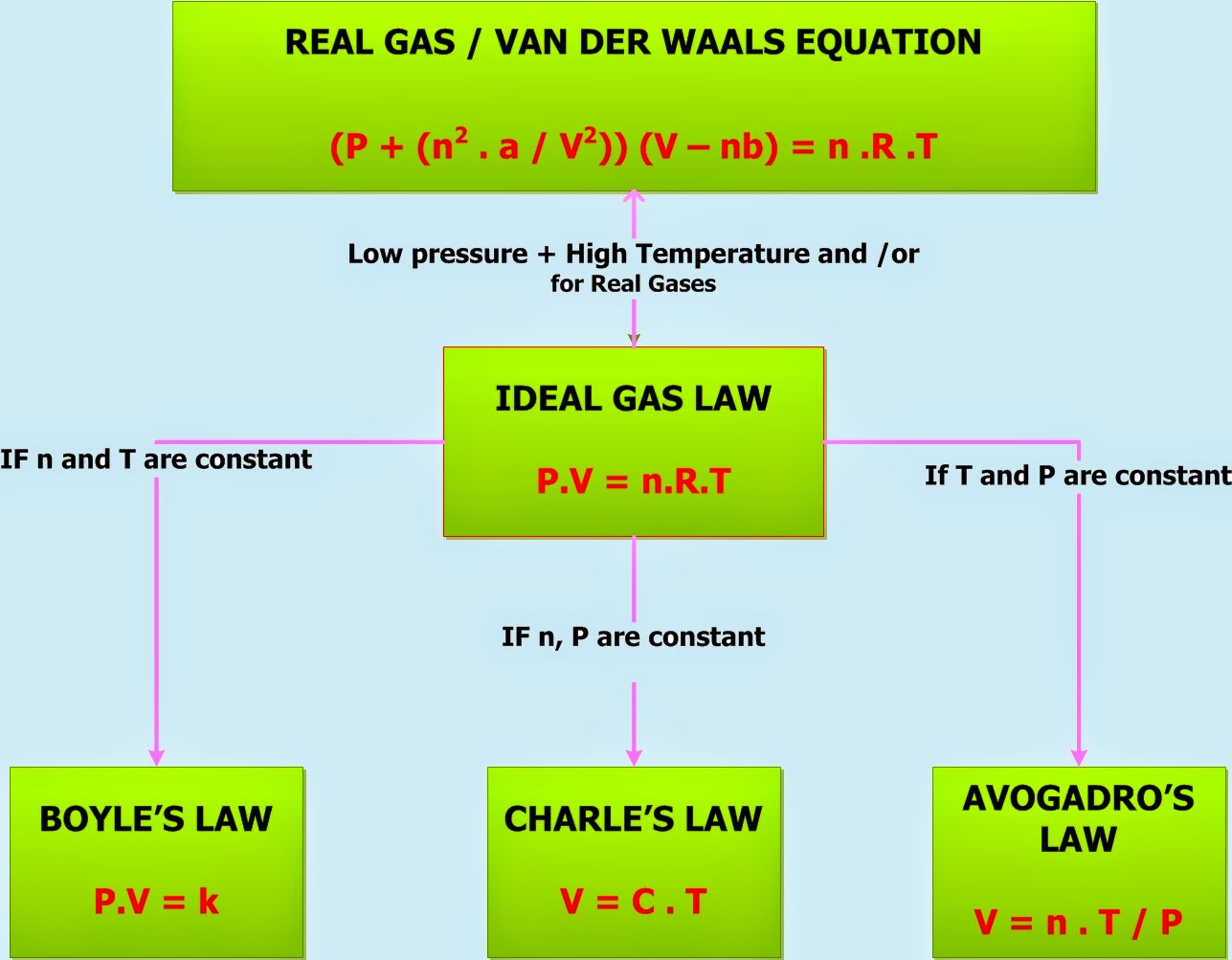
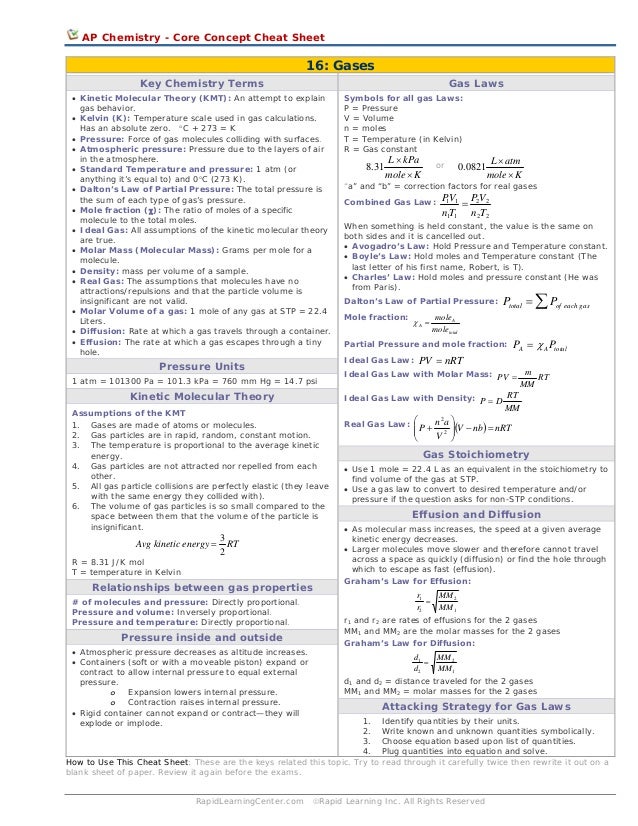
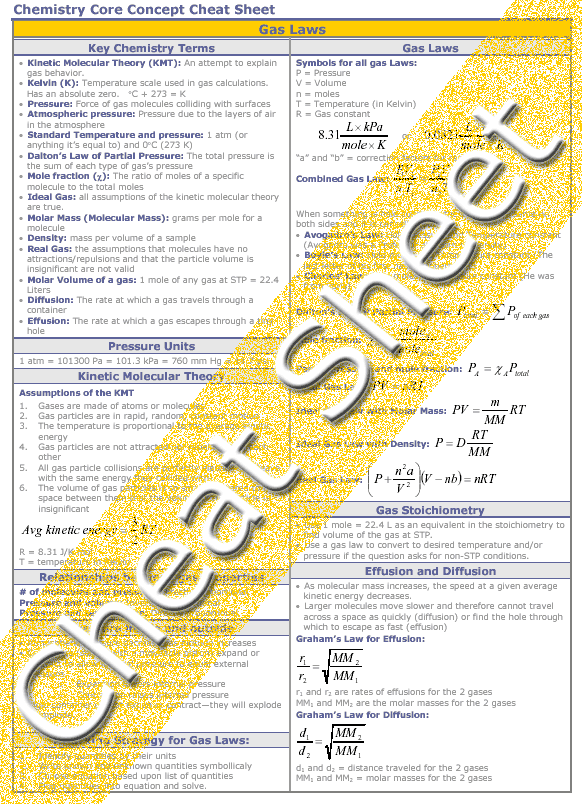
Gas Laws Cheat Sheet - Volume when not given volume, but told to assume ideal gas behavior, use v=1l. Density d=mp÷rt where m is molar mass. The ideal gas law relates the pressure, temperature, volume and moles of a gas through the gas constant “r.” the ideal gas law reduces to the other gas laws when you start holding different variables constant. \[ v = \dfrac{rnt}{p} \nonumber \] and finally get the equation: \[ v \propto \dfrac{nt}{p} \nonumber \] next replacing the directly proportional to sign with a constant(r) you get: The ideal gas law can also relate density and molar mass with the By setting all three laws directly or inversely proportional to volume, you get: Web ðï ࡱ á> þÿ o q. Stp 0 degrees celcius, 273 degrees kelvin, 1 atm, 22.4 l/mol. To relate the amount of gas consumed or released in a chemical reaction to the stoichiometry of the reaction.

PV NRT Gas Laws Cheat Sheet PDF

Gas Laws Cheat Sheet PDF
Gas lawscheat sheet
Gas Laws Ideal Gas Law Chemistry Net
Gas laws cheat sheet Gas Laws Cheat Sheet STP is 1 atm and 0 C K
Gases cheat sheet

Combined Gas Law — Overview & Calculations Expii

Gas Laws Cheat Sheet 2012

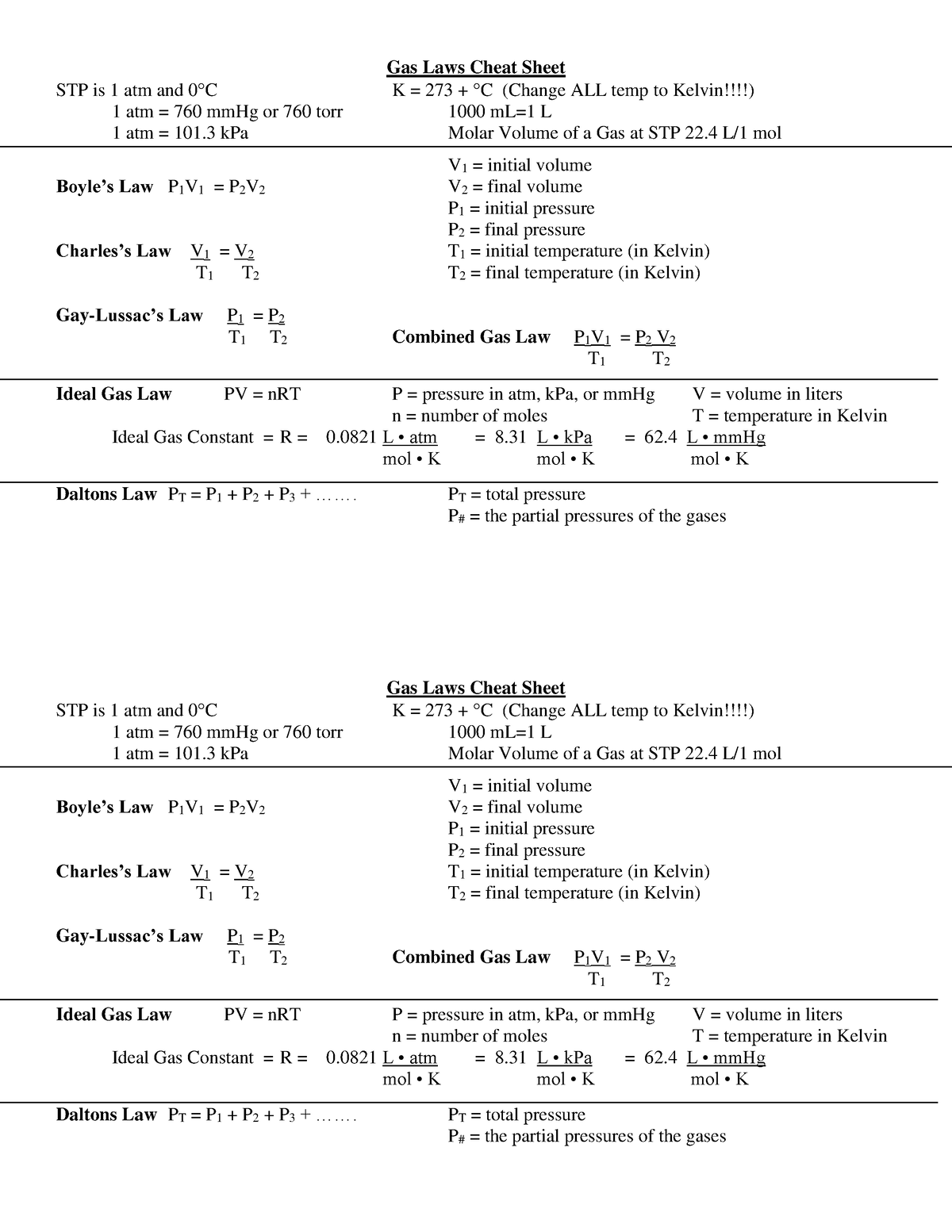
This sheet gives the formulas for the Gas Laws. MA.912.HSAAPR.C
College Chemistry Gas Laws
\[ V = \Dfrac{Rnt}{P} \Nonumber \] And Finally Get The Equation:
Stp 0 degrees celcius, 273 degrees kelvin, 1 atm, 22.4 l/mol. The ideal gas law is the combination of the three simple gas laws. Web using ideal gas law to calculate gas properties. By setting all three laws directly or inversely proportional to volume, you get:
Web To Determine What The Pressure Of The Gas You Are Interested In Is.
Volume when not given volume, but told to assume ideal gas behavior, use v=1l. Web ideal gas law. The ideal gas law relates the pressure, temperature, volume and moles of a gas through the gas constant “r.” the ideal gas law reduces to the other gas laws when you start holding different variables constant. To understand how the ideal gas equation and the stoichiometry of a reaction can be used to calculate the volume of gas produced or consumed in a reaction.
\[ V \Propto \Dfrac{Nt}{P} \Nonumber \] Next Replacing The Directly Proportional To Sign With A Constant(R) You Get:
To relate the amount of gas consumed or released in a chemical reaction to the stoichiometry of the reaction. Web ðï ࡱ á> þÿ o q. Density d=mp÷rt where m is molar mass. The ideal gas law can also relate density and molar mass with the