Master Theorem Cheat Sheet
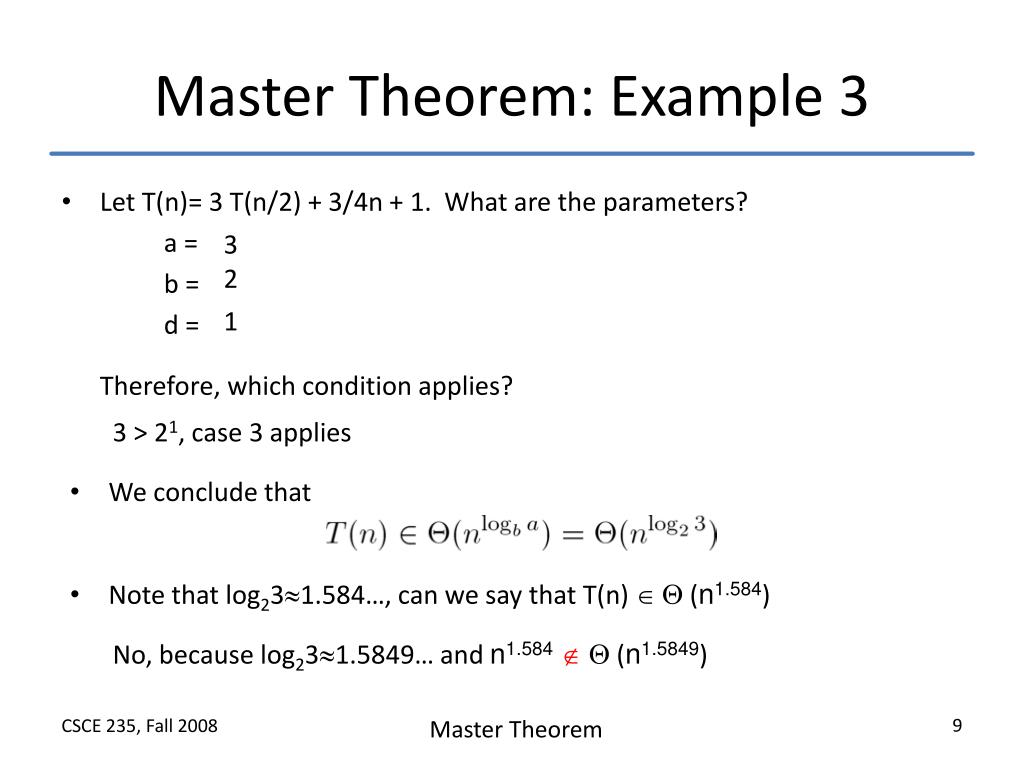
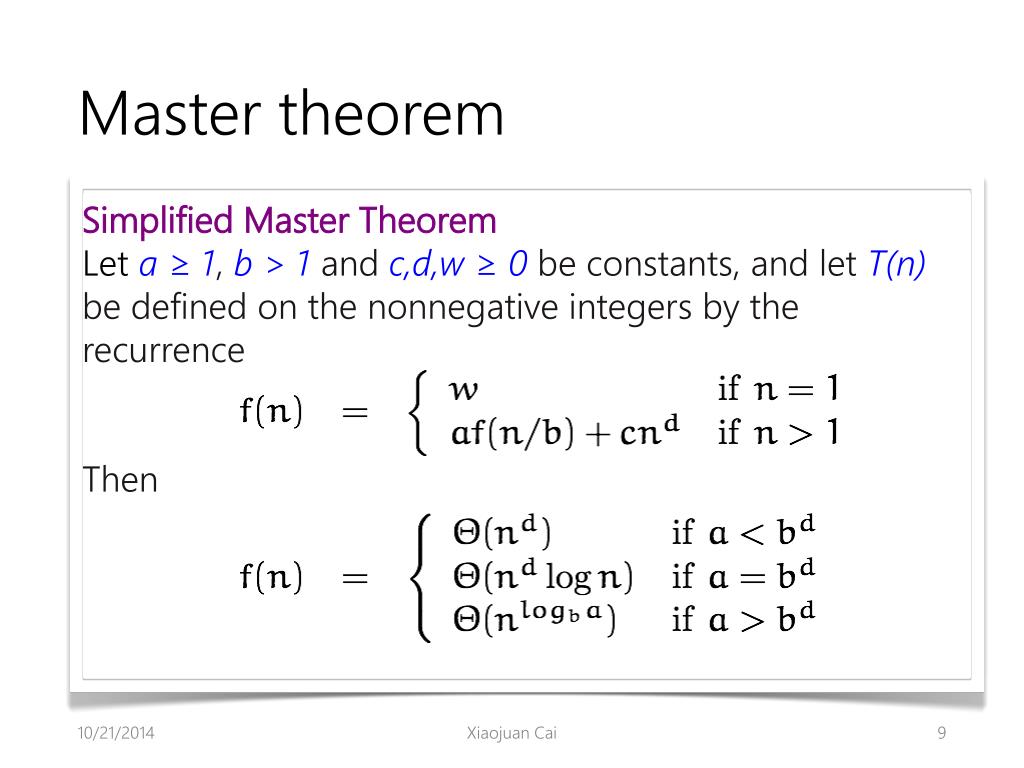
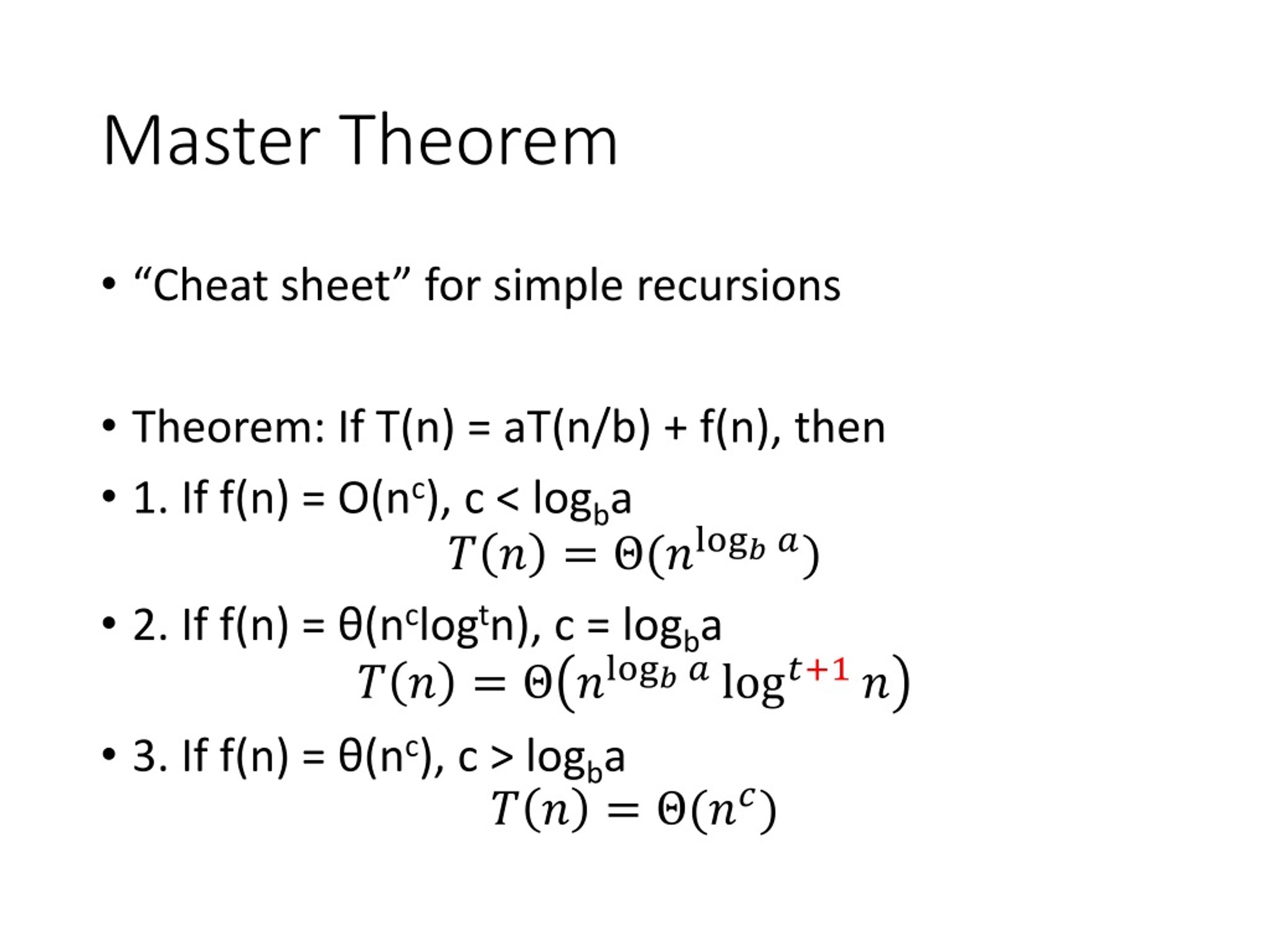
Master Theorem Cheat Sheet - 1) if a > bi then t(n) = θ(nlog b a) (work is increasing as we go down the tree, so this is the number of leaves in the recursion tree). If a ≥ 1 and b > 1 are constants and f(n) is an asymptotically positive function, then the time complexity of a recursive relation is given by. If f(n) = θ(nlogb a logk n) with1 k ≥ 0, then t (n) = θ(nlogb a logk+1 n). If f(n) = (1), we have y = 0; If f(n) ∈ θ(nd) where d ≥ 0, then t(n) = θ(nd) if a < bd θ(nd logn) if a = bd θ(nlog b a) if a > bd 3/25 Web master theorem cse235 introduction pitfalls examples 4th condition master theorem ii theorem (master theorem) let t(n) be a monotonically increasing function that satisfies t(n) = at(n b)+f(n) t(1) = c where a ≥ 1,b ≥ 2,c > 0. For all perfect powers n of b, define t(n) by the recurrence t(n) = at(n/b)+f(n) with a nonnegative initial value t(1. T(n) = c n < c 1 = at(n/b) + θ(ni), n ≥ c 1 has as its solution: Web the master theorem provides a solution to recurrence relations of the form \[ t(n) = a t\left(\frac nb\right) + f(n), \] for constants \( a \geq 1\) and \(b > 1 \) with \( f \) asymptotically positive. 2) if a = bi then t(n) = θ(ni log b n) (work is the same at each.
Master Theorem for Analysis of Algorithm Krantesh Singh

Master Theorem Cheat Sheet r/algorithms
PPT Lecture 2 Divide and Conquer I MergeSort and Master Theorem
PPT Master Theorem PowerPoint Presentation, free download ID1223935

Master Theorem for Analysis of Algorithm Krantesh Singh

algorithm Master theorem Best case big Oh? Stack Overflow
PPT Master Theorem PowerPoint Presentation, free download ID1223935
PPT Master theorem Design divideandconquer algorithms PowerPoint

Master Theorem Exercise
PPT Lecture 3 Divide and Conquer PowerPoint Presentation, free
Web Master Theorem Cheat Sheet.
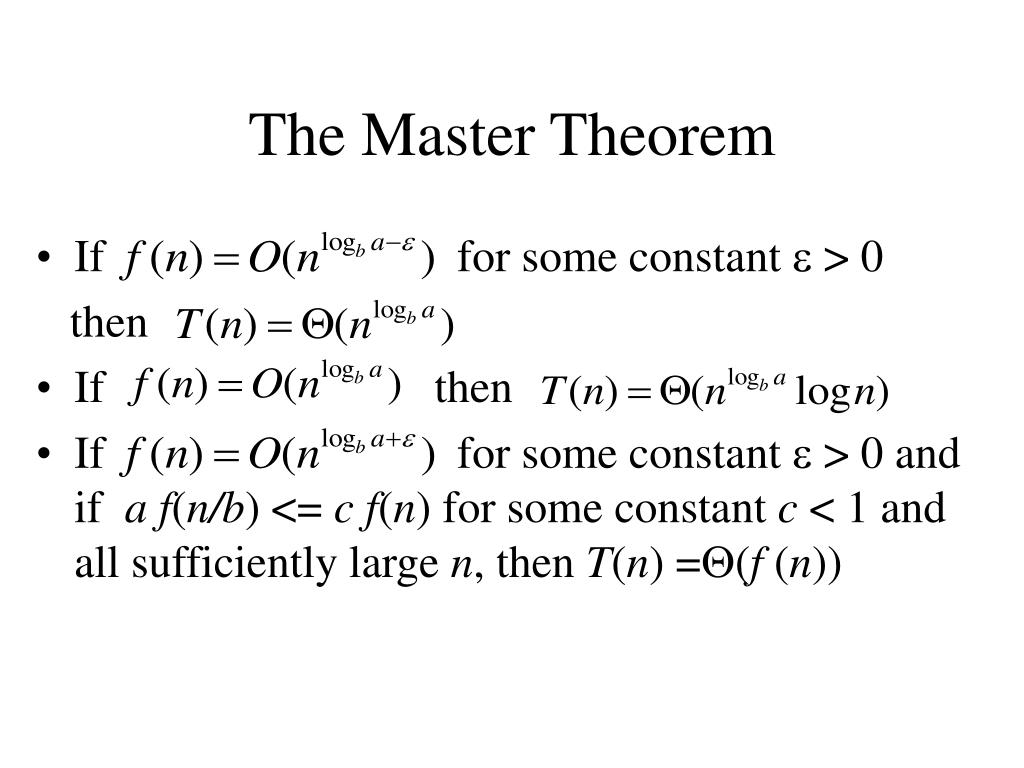
> 0, then t (n) = θ(nlogb a). The master theorem provides an asymptotic analysis for recursive algorithms. One n is white; Given t (n) = at (n=b) + f(n), take the following steps:
Such Recurrences Occur Frequently In The Runtime Analysis Of Many Commonly Encountered Algorithms.
Web 3 less special cases of the master theorem theorem 1 generalizes as follows: I'm a bot, bleep, bloop. I've finished my master theorem cheat sheet. Web the master theorem applies to recurrences of the following form:
T (N) = At(N/B) + F(N) Where A ≥ 1 And B > 1 Are Constants And F(N) Is An Asymptotically Positive Function.
If f(n) = (1), we have y = 0; If f(n) = θ(nlogb a logk n) with1 k ≥ 0, then t (n) = θ(nlogb a logk+1 n). Web simplified master theorem a recurrence relation of the following form: Compute x = logb a.
Web Master Theorem Cse235 Introduction Pitfalls Examples 4Th Condition Master Theorem Ii Theorem (Master Theorem) Let T(N) Be A Monotonically Increasing Function That Satisfies T(N) = At(N B)+F(N) T(1) = C Where A ≥ 1,B ≥ 2,C > 0.
1) if a > bi then t(n) = θ(nlog b a) (work is increasing as we go down the tree, so this is the number of leaves in the recursion tree). If you can, put f(n) in the form (ny logk n), for some constant k 0. T(n) = at(n/b) + f(n) where, t(n) has the following asymptotic bounds: If f(n) ∈ θ(nd) where d ≥ 0, then t(n) = θ(nd) if a < bd θ(nd logn) if a = bd θ(nlog b a) if a > bd 3/25